
Indonesia Silica: Big Resources, Small Output
Indonesia holds 26.4 billion tonnes of silica resources but makes only 0.81% of world sand output. Processing, not deposits, will decide value.
Indonesia's silica resources are huge, but value depends on deposit quality, processing and permits, not on tonnage in the ground.
Report Date: February 10, 2026
Analyst: R. MOH. SHAF HAL JAMIL
Published by: luckresearch.cc
Focus: Silica industry in Indonesia (data cut-off February 10, 2026)
The Short Story
Indonesia has one of the largest recorded silica inventories, yet it makes under 1% of world sand. The gap is not geology. It is quality, permits, processing and buyers. The export ban on raw sand pushes value into domestic processing, which is still small and about a third idle.
Why It Matters
- Ban: Raw sand cannot be exported, so revenue depends on domestic buyers and processing.
- Grade: Cement takes the bulk, but glass and solar glass need low-iron sand.
- Proof: Only deposits with permits and passing grade tests turn resources into sales.
Production and Industry Performance
Output grew 7.10% a year from 2017 to 2022 but swung between 1.6 and 3.1 Mt, so the trend is not smooth.
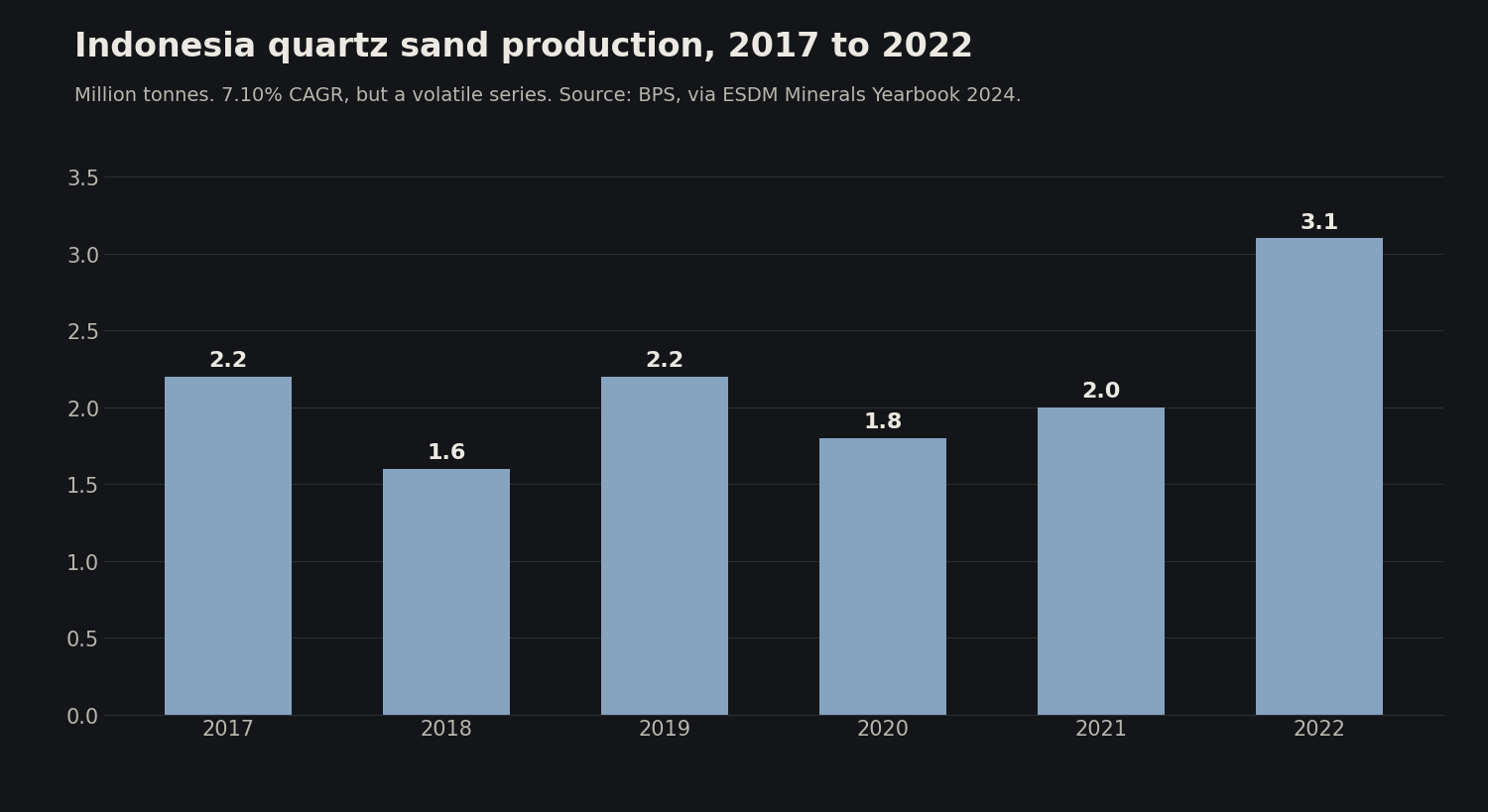
Source: BPS, as reproduced in ESDM Minerals Yearbook 2024.
| Metric | Value | Basis |
|---|---|---|
| Industrial sand output | 3.5 Mt | 2025 estimate |
| Share of world output | 0.81% | 2025 estimate |
| Silica resources | 26.40 bn t | December 2024 |
| Silica reserves | 7.81 bn t | December 2024 |
| Processing capacity | 738,536 t/year | September 2023 |
| Capacity utilization | 65.32% | September 2023 |
Source: USGS Mineral Commodity Summaries 2026; ESDM Neraca 2025; Ministry of Industry (21 processing companies, excluding integrated mines).
Resources were about 13.5 bn t in 2023. The jump came mainly from recorded locations rising from 478 to 611. That is better reporting, not new physical reserves.
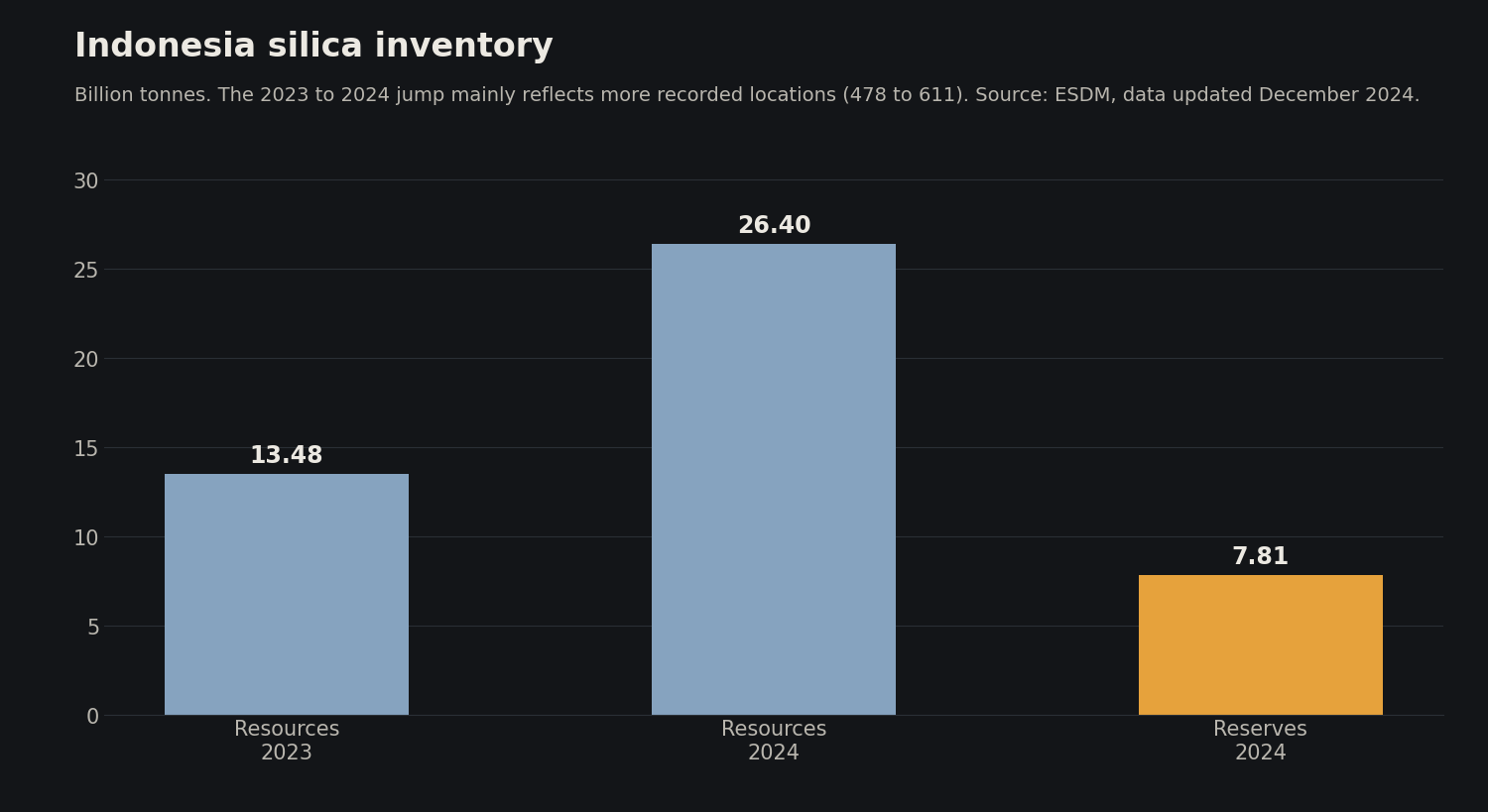
Source: Badan Geologi, ESDM, data updated December 2024.
Analyst View: Big numbers do not prove an advantage.
- Resources are not economic reserves, and reserves are not production-ready without permits and infrastructure.
- Tonnage is not quality. Glass or filtration sand may fail high-purity specifications.
Prices, Demand, and Inventory
Cement took 36% and glass 18% of the 4.52 Mt used in 2022. Solar and chip demand is not yet visible.
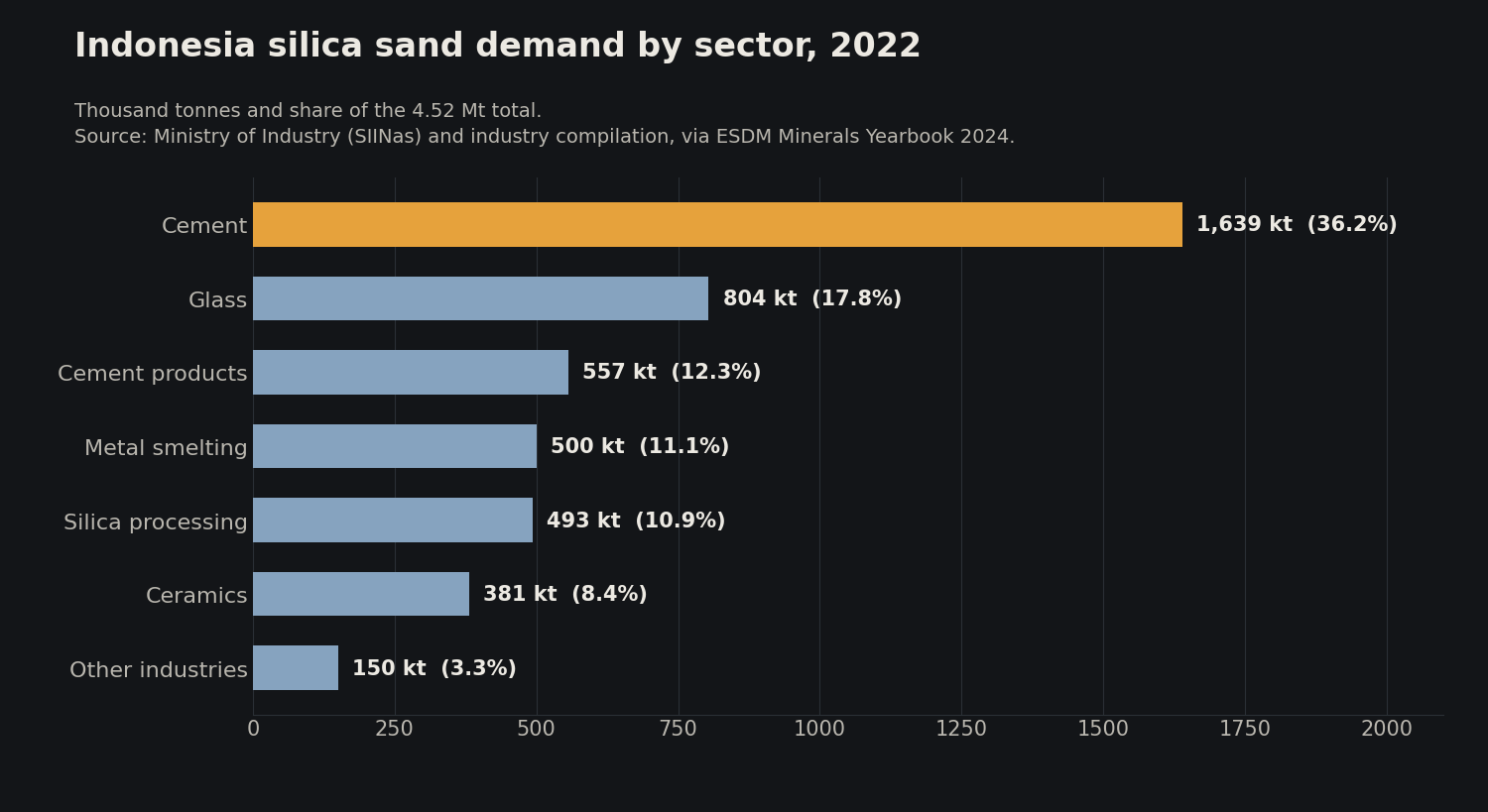
Source: Ministry of Industry (SIINas) and industry compilation, as reproduced in ESDM Minerals Yearbook 2024.
New glass and solar projects are mostly announced, not running. A USD 11.6 billion Rempang plan had no signed contract in January 2025. BKPM's November 2025 study lists three stages of downstreaming: sand processing, higher-spec products such as glass sand, and silicon and specialty materials.
Analyst View: Later stages need far more capital, energy and technology. Judge them on risk-adjusted return, not on the price per tonne.
No Indonesian price benchmark is public. BPS reports quarrying in m³ and USGS in tonnes, so the two cannot be merged.
Policy and Regulation
- Export ban: Raw silica sand and quartz sand (HS ex 2505.10.00) cannot be exported under Permendag 22/2023 and its amendments. Domestic sales and processing decide revenue.
- Permits: An exploration permit is not a production permit. Only production permit allows commercial output.
Risks
- Quality: High-silica sand is not automatically glass-grade. High-purity deposits are rare.
- Processing: Capacity is small compared with deposits, and about a third of it sat idle in 2023.
- Capital and energy: Silicon-stage projects need heavy capital and power, so they are sensitive to energy prices and financing cost.
- Execution: Downstream glass and solar projects may be delayed.
What Would Change the Analyst View
- Processing utilization staying near today's level after new glass and solar plants start would mean demand is weaker than hoped.
- Production permits and lab results showing glass-grade output from new deposits would make the resource case stronger.
Industry Outlook
Analyst View: Positive but selective. Cement and glass remain the base of demand. Solar glass and high-purity quartz are possible upside, but each needs proven grade, recovery rate and customer offtake. The analyst gives no forward CAGR because no comparable public forecast exists.
| Path | What happens | Effect |
|---|---|---|
| Bear | Projects delayed, sand oversupplied | Low utilization, thin margins |
| Base | Gradual processing and glass growth | Selective gains for qualified producers |
| Bull | Solar glass and specialty plants on time, offtake signed first | Higher value mix, better utilization |
These paths are scenario logic, not published forecasts.
What to Watch
- Permits: New production permits.
- Quality: SiO₂ and Fe₂O₃ lab results from new deposits.
- Demand: Commissioning of glass and solar plants, and signed offtake contracts.
Note: 2025 output is an estimate, and the idle share of capacity is the analyst's calculation (100% minus 65.32%).
Sources: USGS Mineral Commodity Summaries 2026 (Industrial Sand); Badan Geologi ESDM, Neraca Sumber Daya dan Cadangan Mineral dan Batubara Indonesia 2025 (data December 2024); ESDM Minerals Yearbook 2024; BPS; Ministry of Industry (SIINas); Kemendag Permendag 22/2023 as amended; Kementerian Investasi/BKPM, Studi Percepatan Hilirisasi Komoditas Pasir Silika (November 2025).
Disclaimer: This report is for portfolio purposes only and should not be construed as investment advice. Investors should conduct their own research and consider their individual risk profiles before making any investment decisions. The author is not a licensed investment adviser. See the full disclaimer.
Detailed explanations are not available to the public. This note is not guaranteed to be revised or updated later.